Dental Practice HR Software Ranked: The 2026 Practice Guide
 by Jonathan Beacher, Founder
Most HR software is built for shops, cafés and offices. Everyone is employed, works fixed days and clocks in at one door. A dental practice doesn't work like that.
Your dentists are usually self-employed. Your nurses often work three or four days a week, and some will pick up extra days when you need them. Your implant surgeon might come in on the last Saturday of the month. And a nurse is a fixed cost whether or not there's a dentist in the treatment room for them to support.
So when a dentist books three days off, the real question isn't "who approves it?". It's "how do I get the nurses who work with them to take leave the same week, so I'm not paying for empty treatment rooms?". Generic HR tools don't ask that question. This guide ranks six tools on the questions a practice manager or owner actually has.
The short answer
- Best for dental practices overall: Pathway. Dentists, nurses, locums and compliance on one rota, with unlimited users.
- Best dental-specific alternative: Agilio iTeam, especially if you already use Agilio's compliance tools.
- Best for a bundled employment-law advice line: BrightHR. A general small-business HR tool: it has no idea of a treatment room, a dentist or a self-employed associate.
- Best simple, low-cost rota: RotaCloud. Built for shops, pubs and care homes, so dentists, treatment rooms and compliance sit outside it.
- Best low-cost all-rounder for small teams: Connecteam. A generic frontline app whose checklists are blank forms, not dental compliance.
- Best for simple HR records on a flat fee: Breathe. Made for office employees, with the rota sold as an add-on and no place for self-employed dentists.
Disclosure: we make Pathway, one of the tools in this list. We ranked every tool against the same seven criteria below, using each vendor's public pages and independent reviews, and we've included where Pathway falls short too. Prices are list prices for a team of 20, checked in October 2026. They vary by region and change often, so confirm them with each vendor.
How we ranked them
We scored each tool on the things that move a dental practice's wage bill and workload:
- One rota (staff schedule) for the whole team. Can dentists, hygienists, nurses, reception and locums sit on the same rota, by room?
- Self-employed clinicians. Does it handle associates who don't book time off or clock in, without forcing them into an employee workflow?
- Non-routine availability. Can it handle the specialist who works every other Friday, or the last Saturday of the month?
- Capacity and leave planning. Does it help you line nurse leave up with dentist absence, and warn you before cover gets too thin?
- Compliance on the same system. Can you see training, checklists and records next to the rota, or is that a separate product?
- Pricing that doesn't punish part-timers. Per-user pricing charges you for every part-time nurse and locum. Flat or unlimited-user pricing doesn't.
- Clock-in that proves presence. GPS geofences are easy to set up but can drift or be faked. Something physical in the practice is harder to game.
At a glance
| Tool | One rota for all | Self-employed | Ad hoc patterns | Leave planning | Compliance |
|---|---|---|---|---|---|
| Pathway | Yes, with locums | Yes | Yes | Yes | Built in |
| Agilio iTeam | Via Dentally | Partial | Via Dentally | Partial | Separate product |
| BrightHR | Basic | No | No | No | H&S add-on |
| RotaCloud | Yes | No | Manual | No | No |
| Connecteam | Yes | Workaround | Manual | No | Generic forms |
| Breathe | Add-on | No | No | No | H&S add-on |
What it costs for a team of 20
| Tool | Per month | What that buys |
|---|---|---|
| Pathway | £97 | HR module, unlimited users. Compliance is included. |
| Agilio iTeam | Quote | Sold as modules; no public prices. |
| BrightHR | £198 | Core HR with rotas, at £9.90 a person. £376 with the advice line. 24 to 60-month contract. |
| RotaCloud | £58 | Rotas, leave and clock-in for 11 to 20 people. About £48 a month paid yearly. |
| Connecteam | $29 to $98 | One hub (scheduling and clock-in) or two (adding HR and training). Billed yearly. |
| Breathe | £61 | Core HR for 11 to 20 people, plus the rota add-on. £84 with training. |
The six tools, ranked
1. Pathway: best for dental practices that want rota, leave and compliance in one place
Pathway is a practice operating system built for dental practices, and HR is one of its modules: rotas, schedules, leave, timesheets, payslips and staff records. It sits next to Pathway's compliance module, so the same team, rooms and calendar drive both.
What it does well:
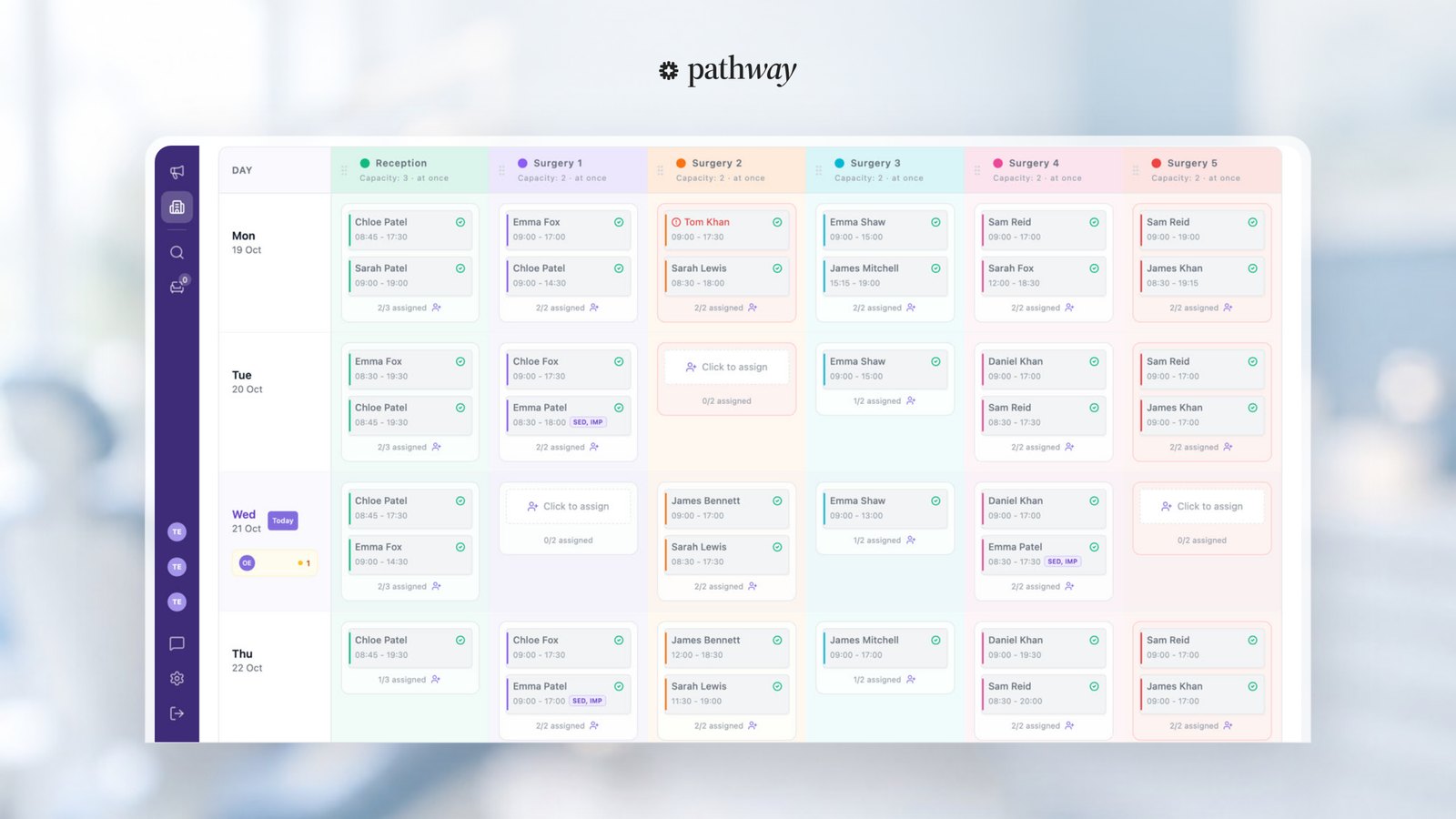
- One rota for everyone. Rooms run across the top, days down the side, and dentists, nurses and reception are assigned to the same grid. When you assign a room you can pick a team member, a saved linked team (a dentist and their usual nurse together) or a locum. Locums sit on the rota by name and role without needing a login, so you can see at a glance how much of next week depends on temp cover.
-
Self-employed clinicians are handled properly. Mark someone as self-employed and Pathway stops treating them like an employee. They log unavailable dates instead of requesting annual leave, and they aren't asked to clock in.
-
Non-routine clinician patterns. Schedules support weekly patterns, rotating multi-week cycles and ad hoc patterns such as "every other Friday", "the last Saturday of the month" or "the 15th of each month". That's how a visiting periodontist or implant surgeon ends up on the rota on the right days without anyone re-typing it.
-
Leave that follows capacity. You set two kinds of rule. Staffing risk rules flag days red when too many people in a role are off. Leave suggestions highlight days green when, for example, at least one dentist is already off, so nurses can see the best days to book their own leave. Both show on the leave calendar and the rota.
-
A year view of everyone's leave. The planning view shows each person's booked leave month by month against what they've accrued and what they have left, with a forecast based on the published rota. Flexible and part-time staff are where leave overpayments usually hide, and this is where you spot them.
-
Compliance connected to the rota. Training records, checklists and audits live in the same platform as the rota. The checklist compliance view shows, day by day, who was on the rota and how many of their required daily checklists they completed. The learning matrix shows who is out of date on training before an inspection finds it.
-
Clock-in tied to the building. Staff clock in by scanning a QR code that keeps refreshing on a tablet at reception, or, where one is fitted, by tapping their phone on a secure NFC tag in the practice. Either way they have to be standing in the practice, not just near it.
-
Unlimited users. Pathway is priced per practice: £97 a month for HR with compliance included, and unlimited users. Adding an as-needed nurse, a new associate or a locum doesn't change the bill.
Where it falls short:
- It doesn't run payroll. You export approved timesheets to your payroll provider or accountant.
- There's no employment-law advice line bundled in. If you want a phone number for disciplinary or contract questions, BrightHR and Agilio both sell that.
- There's no app store app. Staff use Pathway in their phone's browser, which works well but won't suit every team.
- It's newer than BrightHR or RotaCloud, so there are fewer public reviews to read.
Pricing: for a team of 20, £97 a month for HR with compliance included, the same at 5 people or 50. We import your data and the first month is free.
Best for: independent practices and small groups where the rota, leave and compliance are all landing on one practice manager.
2. Agilio iTeam: best dental-specific alternative
Agilio is a well-known name in dental compliance, and iTeam is its HR and rota product. It's the only other tool here built for dentistry from the start. See Agilio iTeam.
What it does well:
- Pulls clinician schedules from Dentally, its partner practice management system, into the rota, so you plan nurses and support staff around hours the dentists have already set.
- Warns you about leave clashes, unassigned shifts and too few nurses per clinician.
- Rotas can be planned up to a year ahead and shared online.
- Bundles an HR advice service covering employee relations, disciplinaries and dental contract reviews.
- Sits alongside iComply (compliance) and training in the Agilio One bundle.
Where it falls short for dental practices:
- Compliance is a separate product. You get the most from iTeam if you also buy iComply, and the products are sold as modules rather than one system.
- Rota management is sold as an add-on to core HR.
- Pricing is quote-only, so it's hard to compare without a sales call.
- We couldn't find anything public on lining nurse leave up with dentist absence, as opposed to warning about clashes. Ask for a demo of that specific case.
Pricing: quote only, modular.
Best for: practices already using Agilio's compliance tools that want everything from one supplier.
3. BrightHR: best for a bundled advice line
BrightHR is one of the best-known small-business HR platforms. Many practices use it for documents, time off and the employment-law advice line that comes with it. See BrightHR.
What it does well:
- Strong core HR: staff records, contracts, time-off requests and absence tracking.
- Blip, its free clock-in app, uses geofences or QR codes to record shifts from staff phones.
- Access to employment-law and health and safety advice, depending on your plan.
- Fixed pricing for the length of your contract.
Where it falls short for dental practices:
- It's built for employees. Self-employed associates don't fit its leave and clock-in model, so most practices keep dentists outside it.
- Reviewers on Capterra and TrustRadius describe the rota as clunky and limited for complex schedules. One says they moved shift planning to a separate tool.
- It doesn't know a dentist from a nurse, so it can't warn you about cover per treatment room or suggest when nurses should take leave.
- Blip relies on phone location. Reviewers report clock-ins failing or staff being clocked out unexpectedly, and there's no offline mode.
Blip's own App Store screenshots: a geofence round the building and a "Coffee Barista" clocking in. Built for any small business, not a dental practice. Source: Blip on the App Store.
- Contracts are typically fixed-term, and cancellation terms are a recurring complaint.
Pricing: for 20 employees, £198 a month on Core HR (£9.90 each), which includes rotas, or £376 (£18.80 each) with the 24/7 advice line. Contracts are fixed for 24, 36 or 60 months, so £198 a month over 36 months commits you to about £7,100.
Best for: practices that mainly want HR documents and an advice line, and plan the rota somewhere else.
4. RotaCloud: best simple, low-cost rota
RotaCloud is a rota and time-tracking tool for shift-based teams in hospitality, retail and care, priced in bands by team size. It's quick to learn and cheap at practice size. See RotaCloud.
What it does well:
- Drag-and-drop rota planning with templates and copying tools, plus labour costs by day, week and month.
- Holiday, time off in lieu, sickness and staff availability patterns are included as standard, not sold as add-ons.
- Clock-in from the staff app with a location check, or from a shared tablet terminal with a PIN and photo (Time & Attendance add-on).
- Free live chat and phone support on every plan.
Where it falls short for dental practices:
- It's built for shifts, not surgeries. There's no idea of a treatment room, a dentist and nurse pairing or a self-employed associate.
- Every user counts towards your band, including you, your managers and any locum with a login, so 21 people puts you in the next band.
- No leave suggestions tied to dentist absence, and no compliance tools. Training, checklists and audits live in another system.
RotaCloud's own App Store screenshots: "Store Assistant" shifts at "The Shambles Store", "Waiting Staff" and "Kitchen Porter" at a pub, and clock-in inside a location circle. Source: RotaCloud on the App Store.
Pricing: for 11 to 20 people, £40 a month for rotas plus £18 for Time & Attendance, so £58 a month, or £580 a year (about £48 a month) paid yearly. Pro is £60 a month plus the same add-on.
Best for: practices that want a cheap, easy rota for employed staff and keep dentists' diaries and compliance elsewhere.
5. Connecteam: best low-cost all-rounder for small teams
Connecteam is an all-in-one app for teams that don't sit at desks, split into three hubs: Operations (scheduling and time clock), Communications and HR & Skills. See Connecteam.
What it does well:
- A free plan for up to 10 users, and low starting prices.
- GPS clock-in with geofences, plus forms, checklists and team chat.
- An easy mobile app for staff.
Where it falls short for dental practices:
- Each hub is a separate subscription. A practice wanting scheduling, time off and training pays for all three, and more geofence sites or schedules need higher tiers.
- Its checklists are generic forms, not dental compliance. There's no dental inspection framework, no audit library and no link between who was scheduled and what they signed off.
Connecteam's own App Store screenshots: a cleaning checklist ("Vacuum carpeting", "Empty all trash cans") and a working-at-heights quiz. Flexible, but every dental check and training topic is yours to write. Source: Connecteam on the App Store.
- Nothing dental-specific: no treatment rooms, no self-employed clinician handling, no link to your practice management system.
- Pricing is in US dollars and changes above 30 users.
Pricing: for 20 users, $29 a month for the Operations hub (scheduling and clock-in) on Basic or $49 on Advanced, billed yearly. Adding the HR & Skills hub for documents and training takes it to $58 to $98. The first 30 users cost the same, so 20 people pay the 30-user price.
Best for: very small teams on a tight budget that can live with a generic setup.
6. Breathe: best for simple HR records on a flat fee
Breathe is an HR platform for small and medium businesses, priced as a flat monthly fee by headcount band rather than per user. See Breathe.
What it does well:
- Clean, simple HR records, time-off and absence tracking.
- Predictable pricing that doesn't rise with every part-time hire.
Where it falls short for dental practices:
- Rota and time tracking are paid add-ons rather than the core of the product.
Breathe's own product image for its rota add-on: jobs called "Tills", "Barista" and "Manager on Duty". Source: Breathe rota.
- Built for employees, so self-employed associates and locums sit outside it.
- No dental capacity planning and no compliance tools.
Pricing: for 11 to 20 people, £44 a month for core HR plus £17 for the rota add-on, so £61. Training (Learn) is £23 more. At 21 people the band changes to £99 plus £34 for rota.
Best for: practices that want tidy HR records and plan rotas elsewhere.
The problems generic tools miss
Your biggest cost is idle nurse time
Nurses are a fixed cost. If a dentist is off for three days and their nurse isn't, you're paying for time with no treatment room to support. As an illustration, a nurse paid 14 an hour (pounds or dollars, the maths is the same) costs 336 over three eight-hour days. Do that a few times a year across a team and it adds up to thousands in wages, before any locum you bring in to cover the other side of the gap.
Generic tools approve leave one request at a time. They can't tell your nurses "your dentist is already off that week, so this is a good week to book". In Pathway, a leave suggestion rule does exactly that, and a staffing risk rule stops the opposite problem: three nurses off on the same Friday.
Part-time and as-needed staff make the rota a strategy problem
Many nurses work three or four days, and some are happy to pick up an extra day when it's needed. That flexibility is valuable, but only if you can see it. Knowing who usually works which days, who could do more, and how much of next week is already covered by locums is what lets you fill gaps from your own team before you pay temp agency rates. We wrote more about this in why dental rotas are so hard.
Dentists don't work like employees
Associates are self-employed. They don't request annual leave, they don't clock in, and specialists often work patterns that don't repeat weekly. Tools built for employees either leave dentists off the rota entirely, which means you plan nurses blind, or force them into workflows that don't fit.
Compliance and HR are the same people
Every checklist, training record and audit in your practice is done by someone on your rota. When HR and compliance sit in separate systems, you can't easily answer simple questions like "who was in on Tuesday, and did they do the opening checks?". That gap is where generic HR tools fall furthest behind.
How to choose
- If you mainly want HR documents and an advice line, BrightHR or Breathe will do the job. Plan the rota separately.
- If you only need a cheap, simple rota for employed staff, RotaCloud does that well. Keep compliance and dentists' diaries elsewhere.
- If you're already on Agilio for compliance, ask Agilio to demo iTeam with your own dentists' patterns.
- If your rota, leave and compliance all land on one practice manager, and your team is mostly part-time, that's what Pathway was built for.
Frequently asked questions
How much does dental practice HR software cost?
For a team of 20, expect about £60 to £200 a month. RotaCloud (£58) and Breathe (£61) are cheapest for a rota and HR records, and Connecteam is $29 to $98 depending on hubs. Pathway is £97 with unlimited users and compliance included. BrightHR is £198, or £376 with its advice line, on a fixed-term contract. Banded and per-person prices rise as you add part-time staff and locums; Pathway's doesn't.
Can HR software handle self-employed dentists?
Most general HR tools are built for employees, so self-employed associates sit outside them. Pathway records them as self-employed: they log unavailable dates and don't clock in.
Do I still need a separate compliance tool?
With most HR tools, yes. Pathway includes compliance on the same platform at no extra cost, and Agilio offers it as a separate product, iComply.
Is geofenced clock-in good enough?
It's convenient, but phone location can drift, fail indoors or be spoofed. A QR code on a tablet at reception, or an NFC tag on the wall, means staff have to be physically in the practice to clock in.
Can I try Pathway with my own rota?
Yes. We import your team and schedules, and your first month is free. Book a walkthrough and we'll show you next week's rota in Pathway.
ready to grow your practice?
Bring enquiries, follow-ups and treatment opportunities into one workflow, so your team can convert more patients without adding more admin.